My earliest memory learning of Pompeii was sometime in grade school when a teacher told our class the story of a city far away, in a time long ago, not long after the time of Christ, when a volcano erupted and people – people just like me – were stopped, literally, dead in their tracks by the unexpected eruption of a mighty volcano, and that this city and these people were actually preserved so that we could now see what their lives were like. I was beyond intrigued. Fast forward to the present time, many decades later. By now, John and I had seen Roman and other ancient ruins all over Europe and Asia, so we were prepared for yet another “pile of rubble,” but, these two ancient cities would astonish us both in terms of preservation and sophistication of the culture.
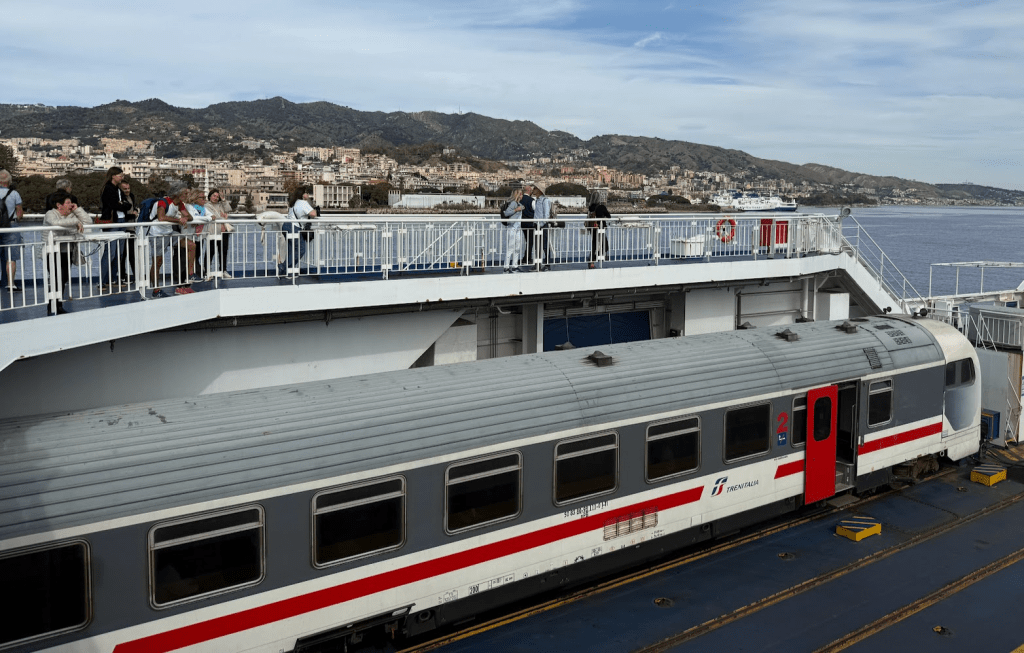
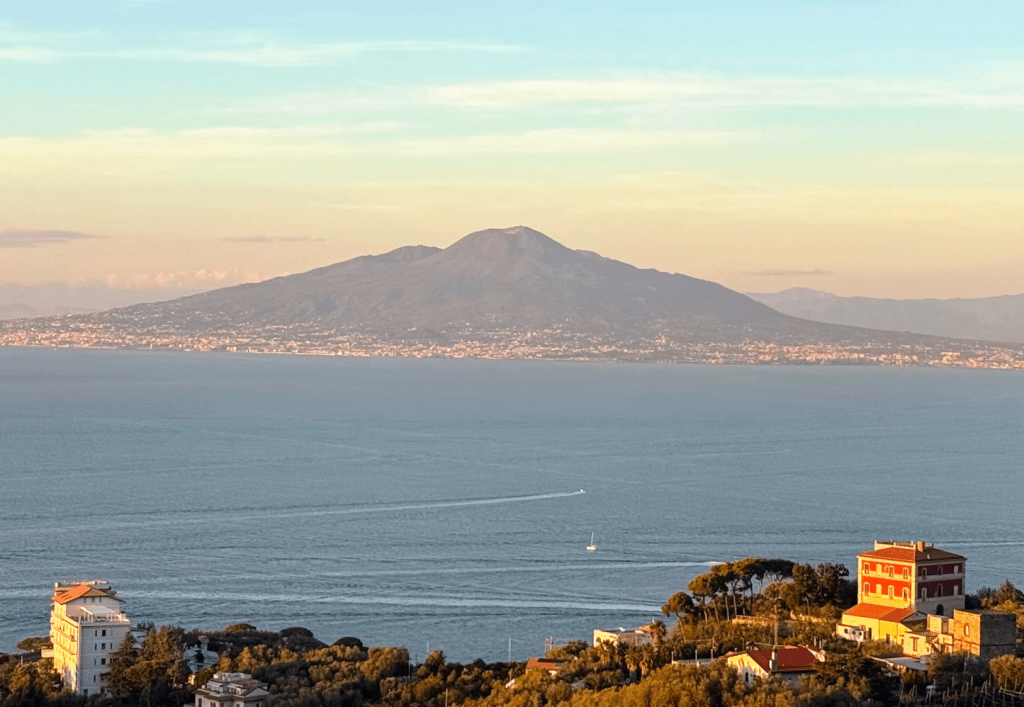
After working our way through Sicily, visiting Palermo, Siracusa, and Taormina, John and I were fortunate enough to be staying in the beautiful Hotel il Nido Sorrento, high above the city of Sorrento with a balcony that looked right onto Mount Vesuvius. On our way to the hotel, we passed the Pompeii exit on the local highway. Never had the recollection of this story from childhood seemed more real. And I have to mention this because it was so cool: to get from the island of Sicily to Sorrento on the mainland, we took a train ferry. Never heard of this? I hadn’t either. A train ferry literally drives the train onto a ferry boat to get across this water, taking us on a 30 minute journey from Messina to Calabria.
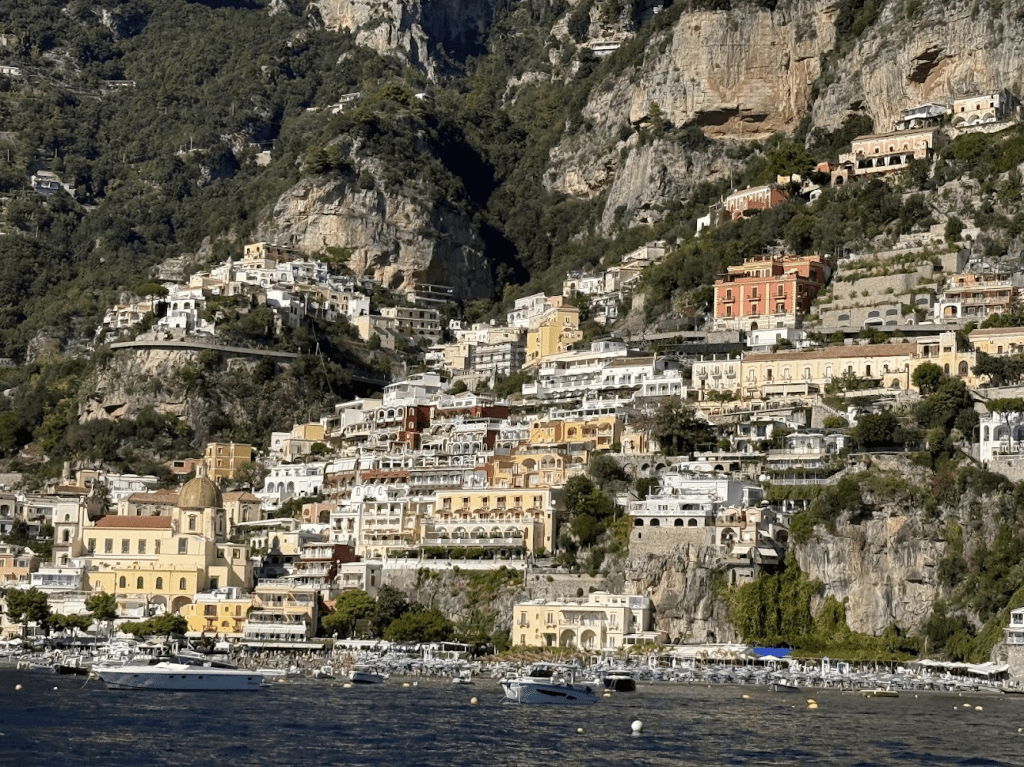
On our first day in Sorrento, we visited Amalfi and Positano on the Amalfi Coast. Ever since seeing the romantic comedy, “Only You” with Marisa Tomei, which features a scene of the characters speeding along the Amalfi Coast in a sports car, I have yearned to drive that coast in a bright red convertible, my hair blowing in the breeze, Robert Downey Jr. (or maybe John) by my side. So, we took a boat tour to visit Amalfi and Positano. Wait – what happened to the convertible?? It turns out that the carefree ride that Robert Downey, Jr. and Marisa Tomei took is a thing of the past and these days you’re in for a slow crawl in a traffic jam. So, a boat trip it was. On the boat, we met a couple from Calgary who had visited Pompeii and Herculaneum already. They raved about the experience and strongly encouraged us to go to the National Museum in Naples before visiting the two ancient cities, as that is where most of the “good stuff” that has been excavated from the archaeological site now resides.
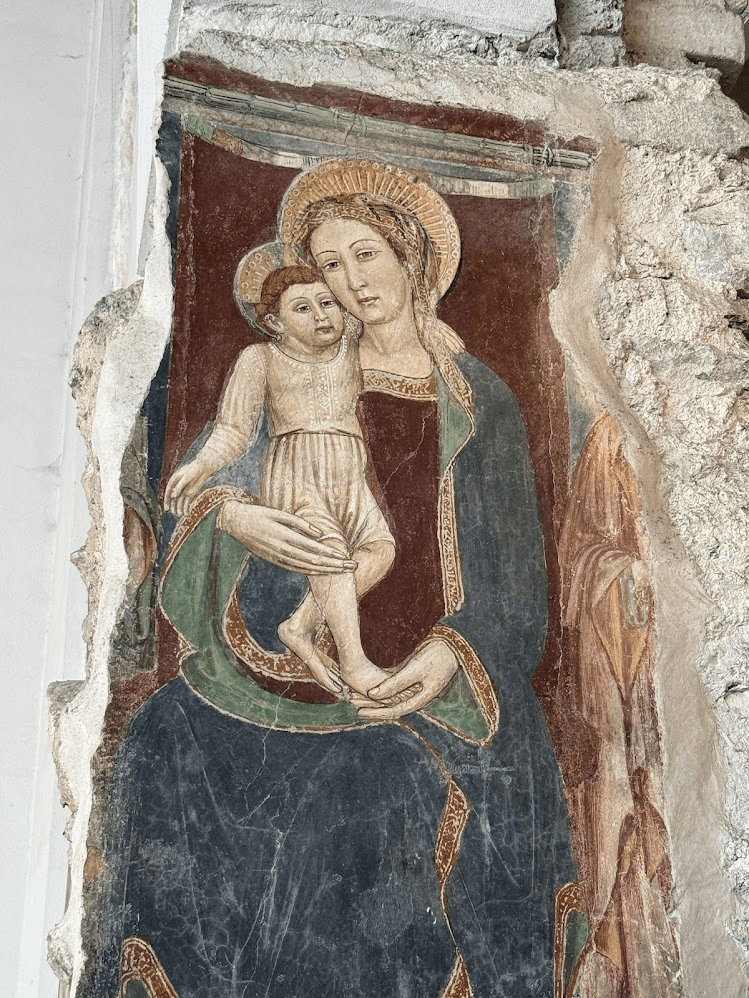
Going to Naples
We had, frankly, been trying to avoid Naples, given its reputation as a seedy, sketchy place with lots of street crime. This impression was reinforced by a story we heard from another traveler in Sorrento. A relative of hers had her car tires stolen from a hotel parking garage in Naples. She reported the theft to the hotel desk clerk who blithely told her that they could arrange to have the tires put back on the car for €400! While we would not be driving to Naples, we would take the Circumvesuviana train, a mode of transportation that is famous for its popularity with pickpockets and is notoriously overcrowded and uncomfortable. Fortunately, we were able to get seats on the train and we and all of our belongings arrived safely at Garibaldi Napoli Station 75 minutes later. After navigating a long line for metro tickets we eventually arrived at the museum.
Visiting the Archaeological Museum
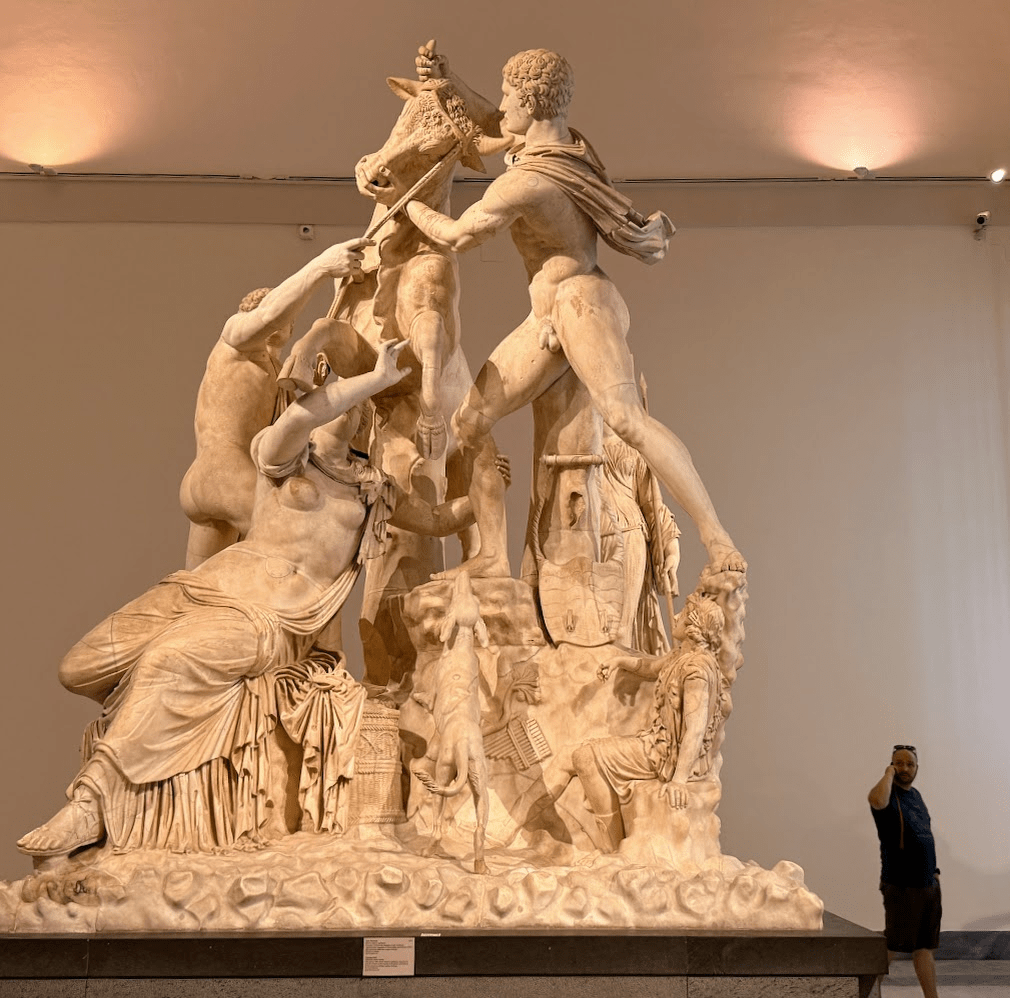
If you can imagine a Louvre of archeology, the Museo Archeological Nazionale di Napoli would be it. It’s overwhelming in size, featuring room after room of treasures from Italy’s rich archaeological past. Needing assistance to guide us to some of the most important pieces and to explain and provide context, we turned to the Rick Steves app on our phones. We spent most of the day in the museum viewing all manner of unearthed treasures, including marble sculptures, gems, mosaics, frescoes, and everyday objects from Pompeii. One of the most impressive treasures we saw was the colossal “Farnese Bull” statue from 222 A.D, which depicts the death of Dirce, first wife of Lykos, King of Thebes who was tied to a wild bull by Amphion and Zethus, the sons of Antiope, who wanted to punish Dirce for the ill-treatment inflicted on their mother. The most fun exhibit was the “Secret Room” which contains very explicit – often hilarious – erotic art from Pompeii.
On to Pompeii…and Herculaneum
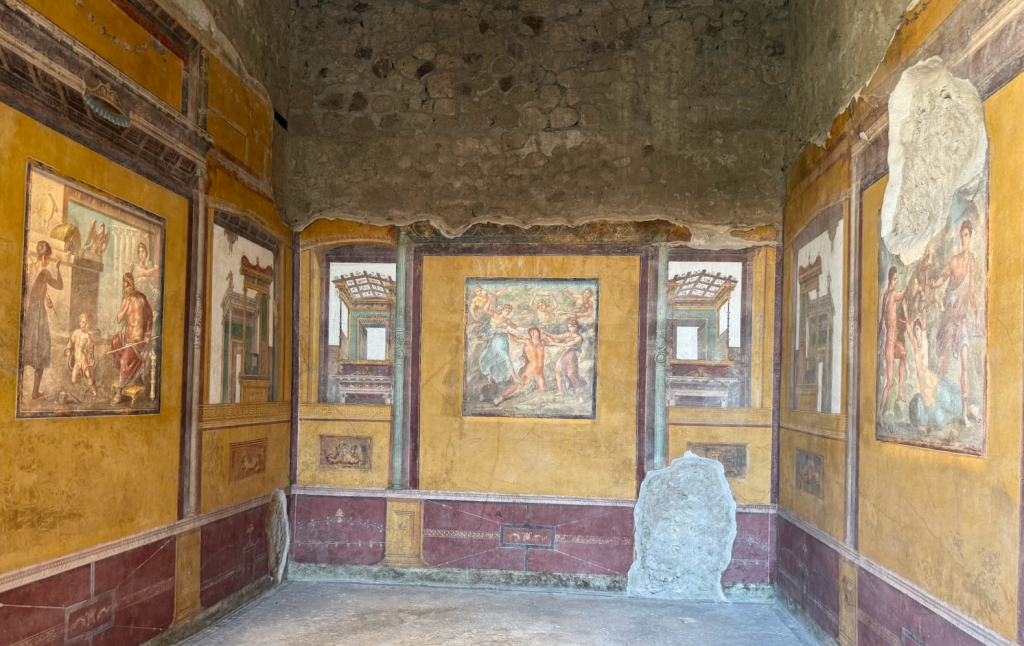
We decided to visit Pompeii the next day, only to get to the train station and learn that there was a one-day train strike, so, we spent our time (happily) exploring Sorrento and headed for Pompeii the next morning. Once again, we boarded the Circumvesuviana and made our way to the Scavi Pompeii station and bought tickets to tour this ancient city. After seeing many archaeological ruins in my life, what sets Pompeii apart is the detail of the city, the ingenious infrastructure that was outrageously ahead of its time, and the glimpse of ancient life it provides. One is constantly reminded of how much life in ancient Pompeii is similar to our lives in today’s modern world. In the forum, we visited a hall of justice (the Basilica) and a Granary where produce was sold. There are public baths (men’s and women’s) that are intricately decorated in tiles and a “snack bar” for taking meals, a shopping street that was cleverly closed to chariot traffic with stone bollards, a bakery, a tavern, and a brothel (complete with comments on the services provided written on the walls). We saw homes, one belonging to two wealthy brothers, and another of a wealthy merchant. Throughout, there were mosaics and frescoes (some were copies, as the originals reside in the museum in Naples). The streets were quite advanced for the time, with raised sidewalks to hide plumbing and keep Pompeiians from getting their sandals wet. We even saw an aqueduct arch. The audio guide kept us moving along and also explained the details of what we were seeing.
Next, we were on to Herculaneum, which created another set of train challenges. Since the Circumvesuviana did not have a stop at the Herculaneum Ercolano station on the day/time we were travelling, we were forced to either hire a car to take us there or figure out how to get there on the Compania Express, another tourist train that offers reserved seating AND air conditioned cars, but only travels four times per day. After some effort, we successfully sorted this out, bought a ticket on the Compagnia Express, and, from there, it was easy peasy.
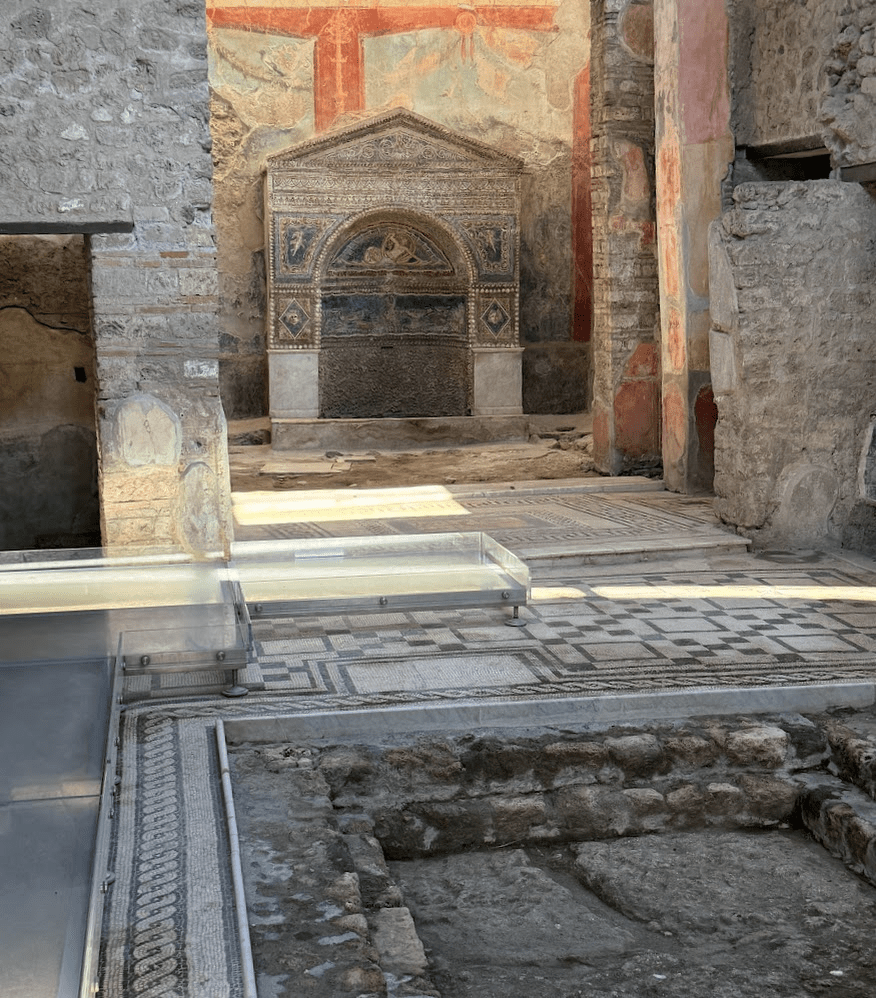
So, what’s the difference between Pompeii and Herculaneum?
We did ask ourselves if it made sense to see yet another ancient city destroyed by Mount Vesuvius, and it turns out there are good reasons to see both. Herculaneum is much smaller than Pompeii but is better preserved. One writer expressed the difference between the sites in this helpful way: Pompeii impresses with its vastness, while Herculaneum charms with its detail. Part of the difference between the two lies in the character of the cities themselves. Pompeii was large and prosperous city, while Herculaneum was a wealthy seaside resort. The other difference is in the way the cities were preserved. Pompeii was buried under a thick layer of volcanic ash and pumice that rained down for hours. This covered walls, collapsed roofs, and eventually suffocated the city. While many stone structures survived, wooden elements and delicate organic remains usually did not. Herculaneum, on the other hand, was hit by a superheated pyroclastic surge. Ironically, this destroyed some structures but carbonized and preserved organic materials such as wood, food, textiles, and even papyrus scrolls. Today it’s possible to still see ancient wooden furniture, beams, doors, and even the remains of food in shops. This level of preservation is extraordinary and offers a unique look into daily life.
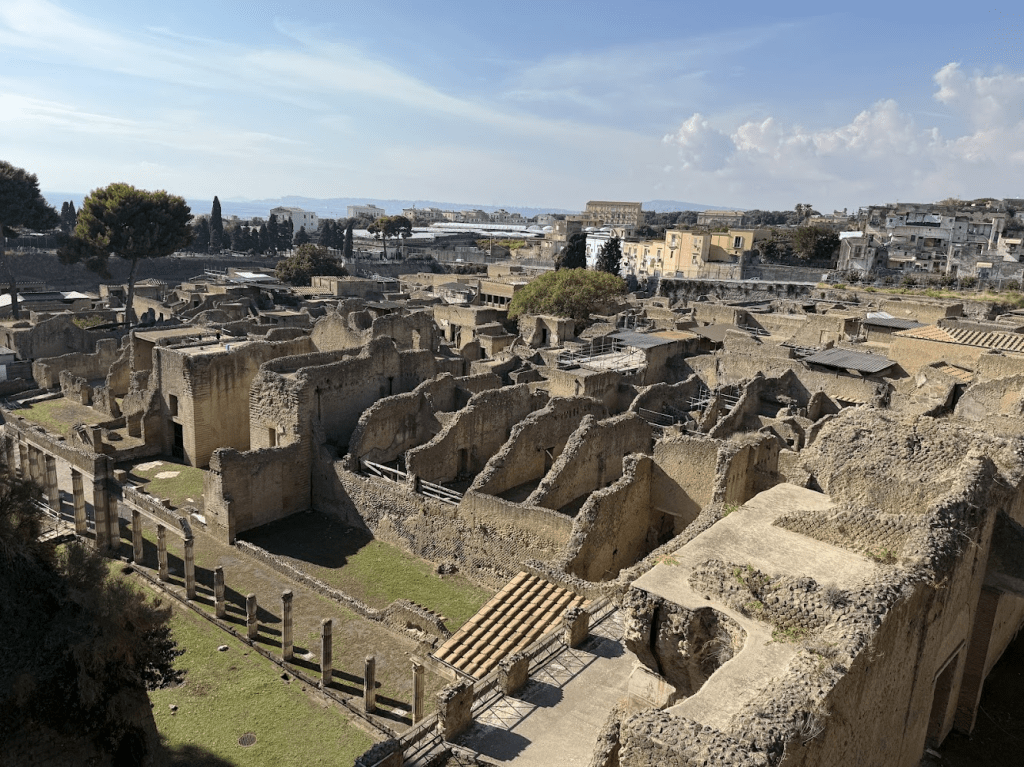
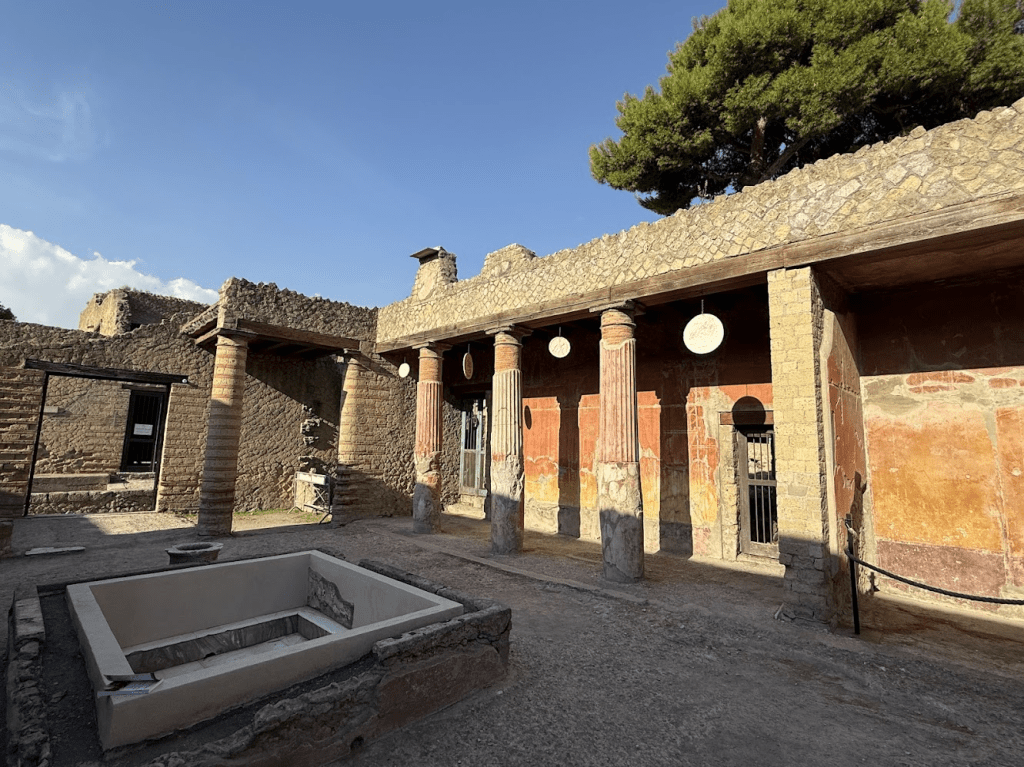
For anyone making the trip to this part of the world, I would definitely recommend a visit to both Pompeii and Herculaneum. The easier way to do this is to hop on one of the many tour busses which will pick you up from your hotel, provide a tour guide for the sites, and easily transport you between the two. But when have we ever chosen the easier way?

 You and Me, Odyssey
interesting! Thanks for sharing your travel adventures.
LikeLike
Thanks, Sharon!
LikeLike