I first heard about Carlsbad Caverns when I was just a kid. In the storied way of Americans in the 1960s, neighbors of ours took a family trip out West in their station wagon, as in “See the USA in a Chevrolet.” One of the daughters came back brimming with stories of the trip, especially the amazing caves they saw: Carlsbad Caverns. Since I had never even seen a picture of a cave larger than someone’s living room, I couldn’t imagine anything like it. Then, five years ago, John and I visited the Škocjan Caves in Slovenia, and I finally understood what my childhood playmate was talking about. The Škocjan Caves are impressive enough that I felt that I had seen all the caves I needed to see and could just skip Carlsbad Caverns here in the U.S. And yet, we were going to be driving right past Carlsbad National Park and it seemed a shame not to stop and check it out.
And so it was that we arrived at Carlsbad Caverns National Park in the afternoon on a Monday in early October, the timing not by design, but happenstance, and it turned out to be perfect. The park was still observing timed entries by reservation, but the crowds were light enough that day that we drove right in. Once there, we found that there was no line for entrance to the cave tour which is, apparently, unusual. We had been forewarned to dress properly, as the caves are damp and cold year round. My light jacket was perfect for keeping out the chill.
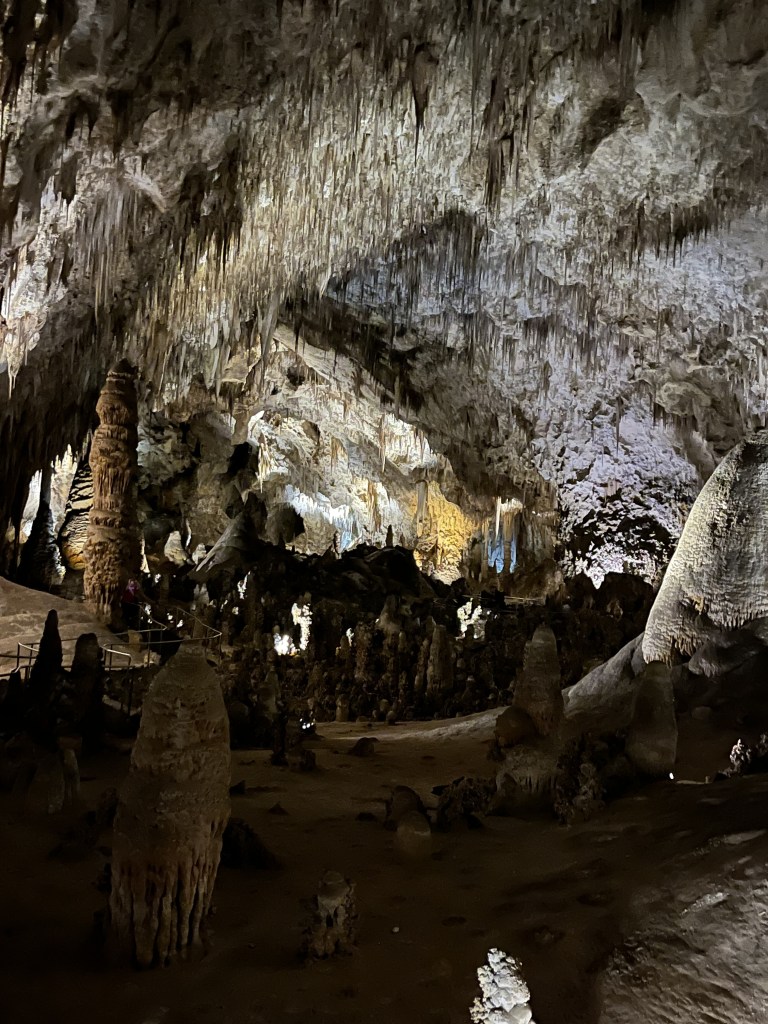
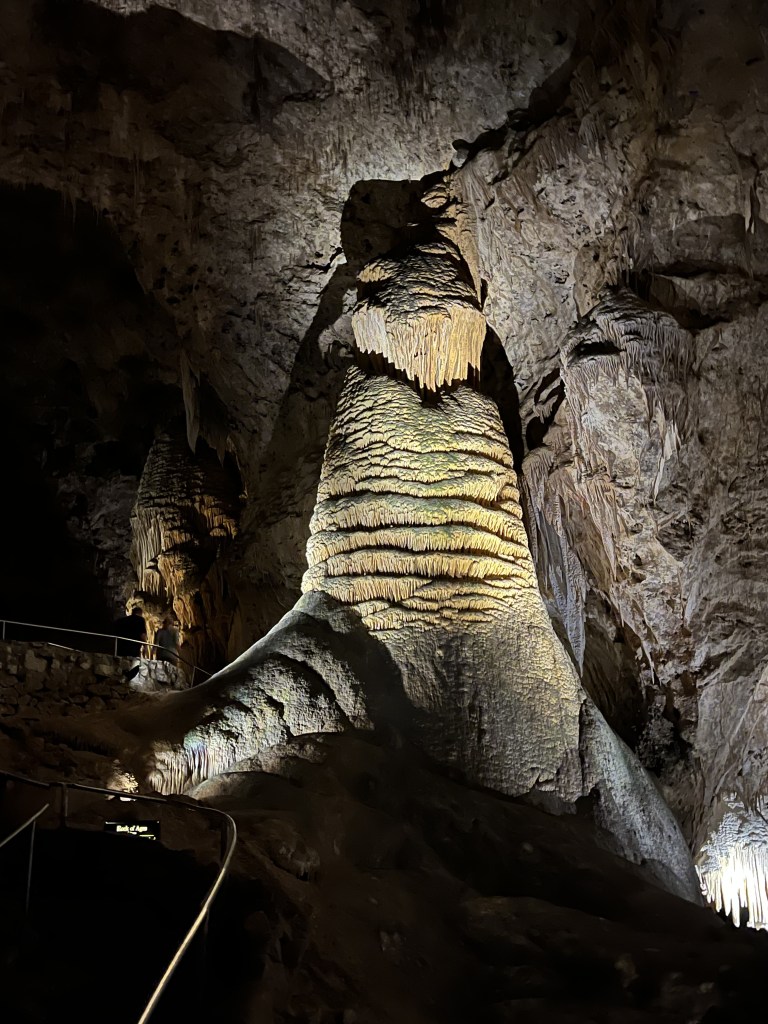
In spite of my ambivalence about visiting Carlsbad, I was immediately struck by the vastness and scale of this incredible labyrinth and the exquisite beauty of the cave features. It was truly a case of nature creating awe-inspiring sculptures. The audio guide that came with the tour did a nice job of leading us through our visit, pointing out the uniqueness of the cave features, their history, and their importance in scientific study.
The Discovery of Carlsbad
Of course, Native Americans have known about the cave for hundreds, if not thousands, of years, long before they were discovered by white people. The first known and credited cave exploration took place in 1898 by a sixteen-year-old cowboy, named Jim White. White was drawn to the cave by what he thought was smoke but turned out to be thousands of Brazilian free-tailed bats – these bats live in the caves to this day. He did not enter the cave right away but returned another day with wood and wire to construct a makeshift ladder, allowing him to descend into the cave carrying a torch. He returned to the cave again and again and, eventually, brought others with him. The Caverns eventually became Carlsbad Caverns National Park in 1923.
Walking around the massive space, carefully illuminated with lighting planned by a Broadway lighting designer (I’m not making this up), I imagined what it must have been like in the cave as it was for young Jim White, with no walkways and only a torch to light the way. The caves are so vast with so many pools of water and low hanging limestone formations, it must have been terrifying. It would have been so easy to get lost and never find the way back out!
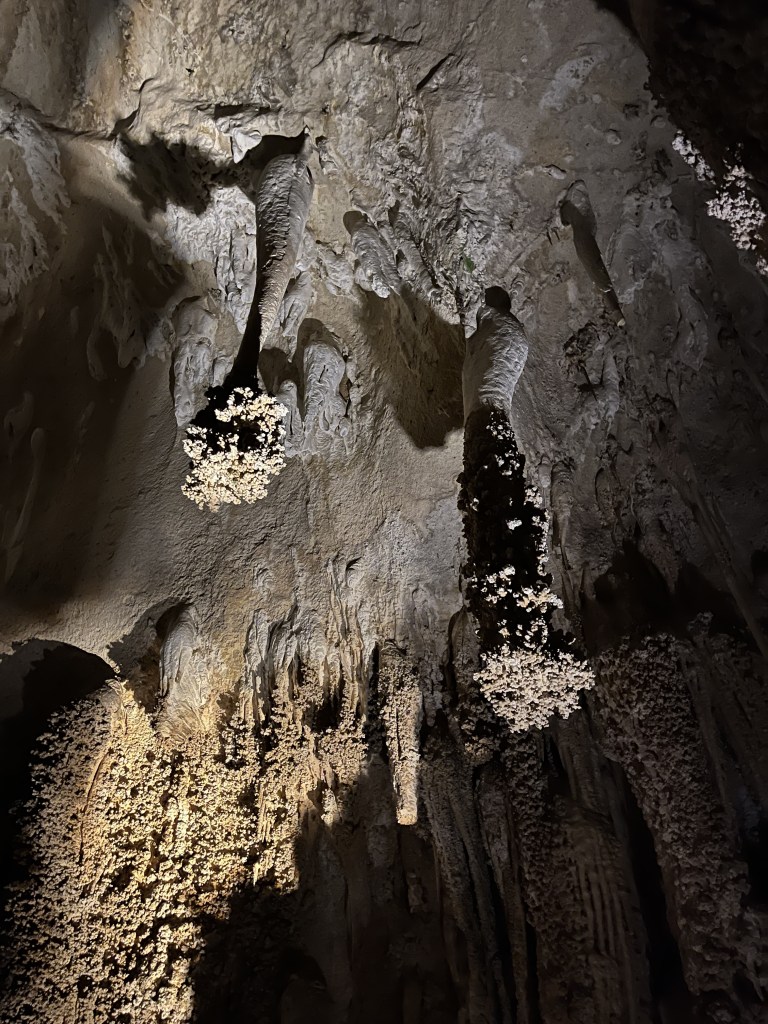
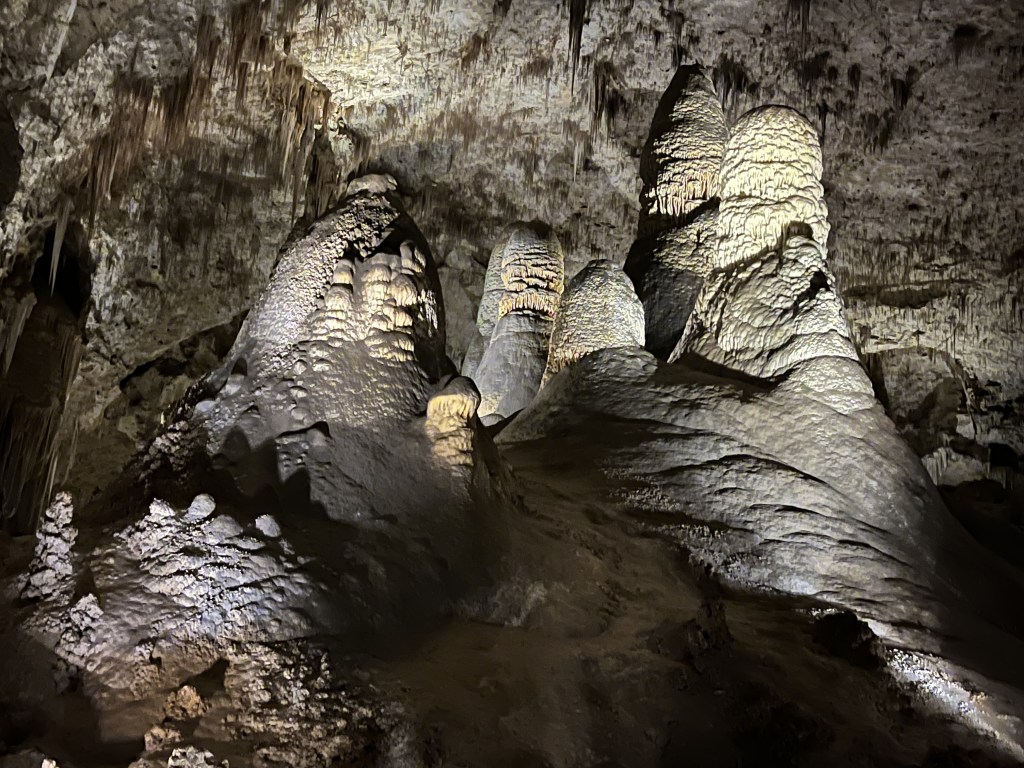
We also learned during our tour about nearby Lechuguilla Cave, a much larger cave than Carlsbad at over 150 miles in length (Carlsbad is around 30 miles) and 1600 feet deep, and is the eighth longest cave in the world. Research studies are carried on in Lechuguilla Cave in the discipline of speleology, which encompasses a wide range of disciplines including geology, hydrology, biology, archaeology, and microbiology, primarily focusing on cave formation and the unique ecosystems within caves, using cave features such as stalagmites to study past climate changes. The location of Lechuguilla Cave is a well-guarded secret, and admission is only open to scientists who can provide credentials and the purpose of their visit for scientific study. These restrictions are necessary to keep the fragile ecology of the cave intact.
But wait, there’s more…the evening bat flight!
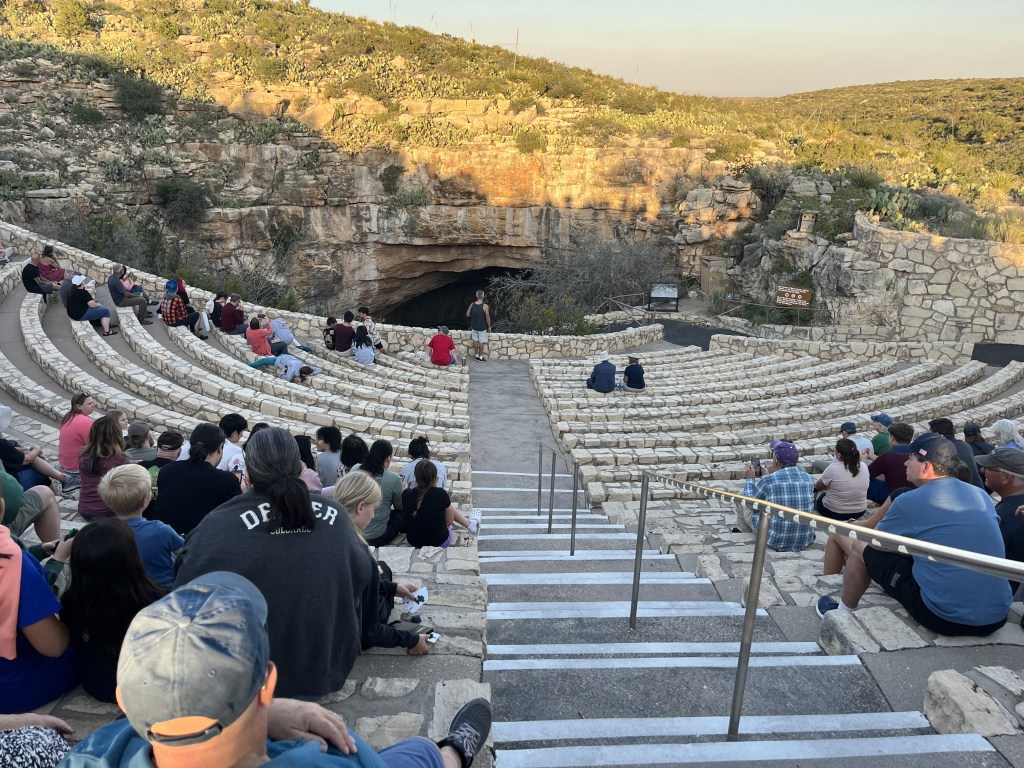
At the end of the day, we departed the caverns to check in to our hotel in Carlsbad, NM, 40 minutes north of the park. After freshening up, we drove back down to Carlsbad NP for the evening bat flight held near sunset every night from April through the end of October. Dates are determined by the presence of the bats, which migrate to Mexico, departing sometime from late October to early November. The bat flight is held in an amphitheater built for this purpose and is preceded by a ranger talk, which ends abruptly as soon as the first few bats exit the cave, as the bats are sensitive to noise. The bats, which number from 200,000 to 500,000 nightly, exit the cave and fly north in the direction of the Pecos River where there is water and an abundance of the flying insects that make up their diet. They return the next morning at dawn in a flight that is reported to be just as impressive as their exit from the cave but, of course, we were snuggled in our beds at our hotel in Carlsbad by then.

 You and Me, Odyssey
OK – Had to change my password to get in, but here I am. Great story and awesome photos; I hope I make it here someday.
LikeLike
Hi Sallie,
I am just seeing this. Fabulous account of Carlsbad! Just loved it. Thanks so much!
Gwen
>
LikeLike